
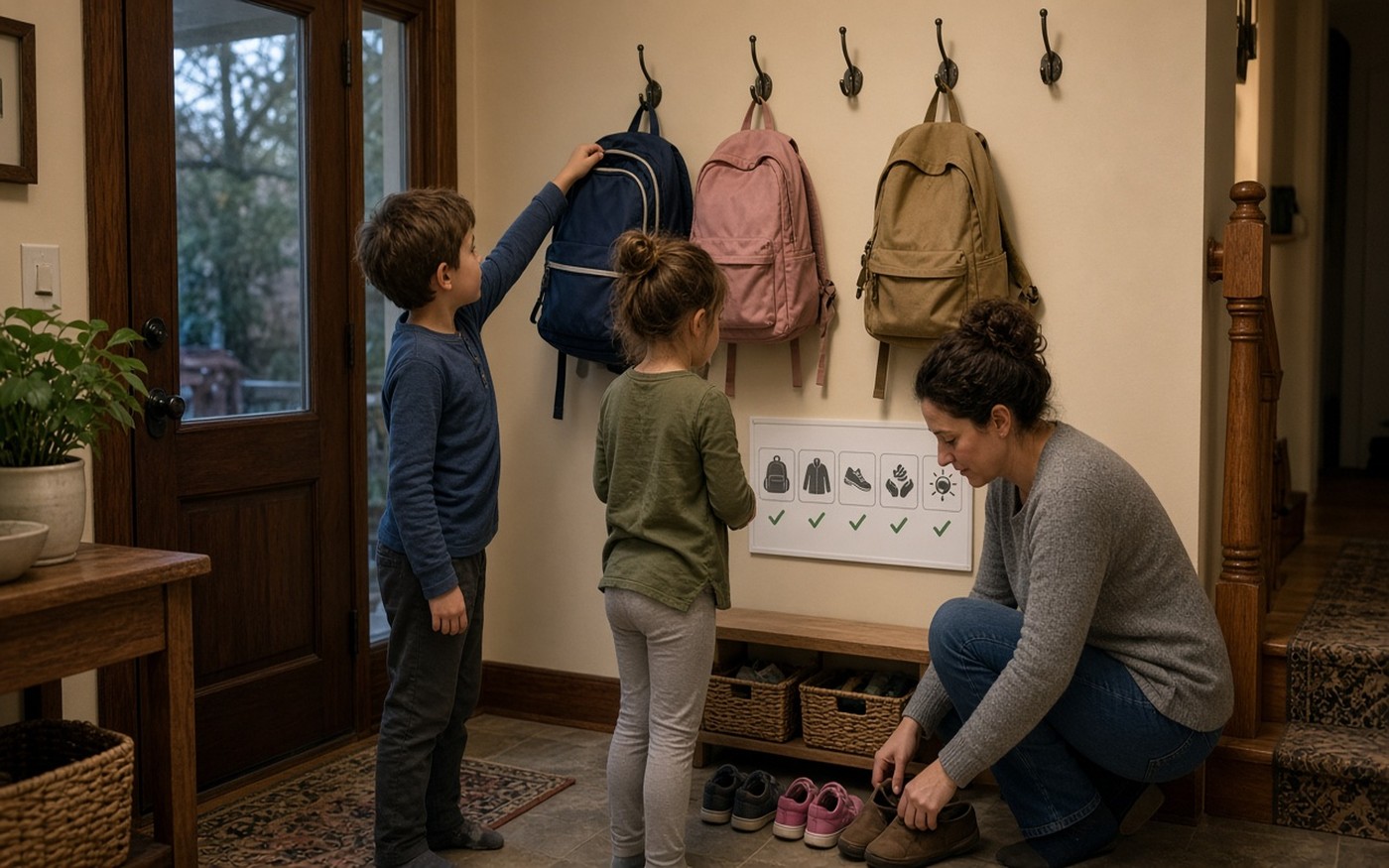
School mornings, bedtimes, after-school hours, and the feelings that blow up in between work better when they have a short, visible sequence. This hub gathers every BabyMumbo guide about weekday rhythms, sleep, screens, homework, and the behavior skills that make a house livable: waiting, sharing, apologizing, and talking about feelings.
Start with the routine that is currently falling apart, not with a whole-house overhaul. If the job is a skill like tying shoes or washing hands, our life skills guides may be the better door. Mealtime routines live in the mealtime guides.
School logistics—mornings, buses, lunches, and conferences—also have their own door in our school-day guides. Bedtimes, naps, and nights away are gathered in the sleep guides.
Weekday and school rhythms
- School Morning Routine Checklist That Cuts Chaos — A night-before reset and a visual checklist that gets you to the door.
- A School-Bus Routine That Survives a Regular Tuesday — A Tuesday-proof bus rhythm, from the stop to the backpack hook.
- After-School Routines That Reduce Chaos — A landing pad, a snack, and a sequence that reduces the witching hour.
- Packing a Kids Backpack the Night Before (A Habit That Sticks) — Pack the bag the night before so morning is not a scavenger hunt.
- Homework Habits That Actually Stick (Elementary School) — A window, a good-enough workspace, and independence scaffolds.
- The First Day of Kindergarten: A Week of Firsts — A week of firsts, not a single high-pressure morning.
- Preschool Drop-Off Without Tears: Separation Anxiety Scripts That Work — Short drop-off scripts that help everyone leave.
- When to Start Preschool: Ready Is a Season, Not a Birthday — Ready is a season, not a birthday.
- Parent-Teacher Conference Questions That Get Real Answers — Questions that get real answers in a short meeting.
- Screen Time Rules by Age—Without the Guilt Spiral — Enforceable rules, with labeled exceptions for trips and sick days.
Sleep and nights
- Bedtime Routines for Toddlers & Preschoolers That Stick — A five-step skeleton that cuts stalling.
- Fear of the Dark: Nighttime Scripts for Toddlers and Preschoolers — Nighttime scripts for dark rooms and big feelings.
- Transitioning Off Naps (Without Losing Bedtime) — Give up the nap without losing bedtime.
- Crib to Toddler Bed: When and How to Make the Switch — When and how to make the switch.
- Weaning Off the Pacifier: A Gentle Plan That Sticks — A gentle plan that can actually stick.
- Overnight at Grandparents’: A Plan That Helps Everyone Sleep — A smaller night away, with a clear handoff.
- Kids First Sleepover: A Short, Close-to-Home Plan — A short, close-to-home first sleepover.
- Leaving Kids with a Babysitter for the First Time — The first evening out, with a plan the sitter can run.
Feelings and behavior
- Talking to Kids About Feelings: Building Emotional Vocabulary — Name the feeling, then listen, in language they can use.
- Toddler Tantrums in Public: Scripts That Actually Help — Short scripts, and permission to leave if you need to.
- Toddler Hitting and Biting: How to Stop It and Teach What’s Next — Stop the harm, then teach what comes next.
- Sibling Rivalry Scripts That Calm the Fight — Safety first, then repair, without a forced hug.
- Teaching Kids to Wait Without Constant Meltdowns — A waiting skill for ordinary delays, not constant lectures.
- Teaching Kids to Share Without Constant Refereeing — Sharing without a parent as a full-time referee.
- Teaching Kids to Apologize (and Mean It) — An apology they can mean, not a performance.
- Teaching Kids Sportsmanship (Including How to Lose) — What they do after the play ends, including how to lose.
- Teaching Kids Gratitude in Everyday Moments — A small daily ritual, not a personality test.
- Preparing a Toddler for a New Baby: A Calm First Months Plan — A calm plan for the first months with a sibling.
- Teaching Kids to Be Good Guests (Without a Driveway Lecture) — Guest habits without a driveway lecture.
- Hosting a Playdate That Doesn’t Wreck Your Afternoon — A playdate that does not wreck the afternoon.
The bottom line
A routine is a short sequence you can repeat on a Tuesday, and a behavior skill is what you practice when the sequence wobbles. Pick the one guide that matches this week, try the smallest version of it, and come back to this hub when you need the next one.