
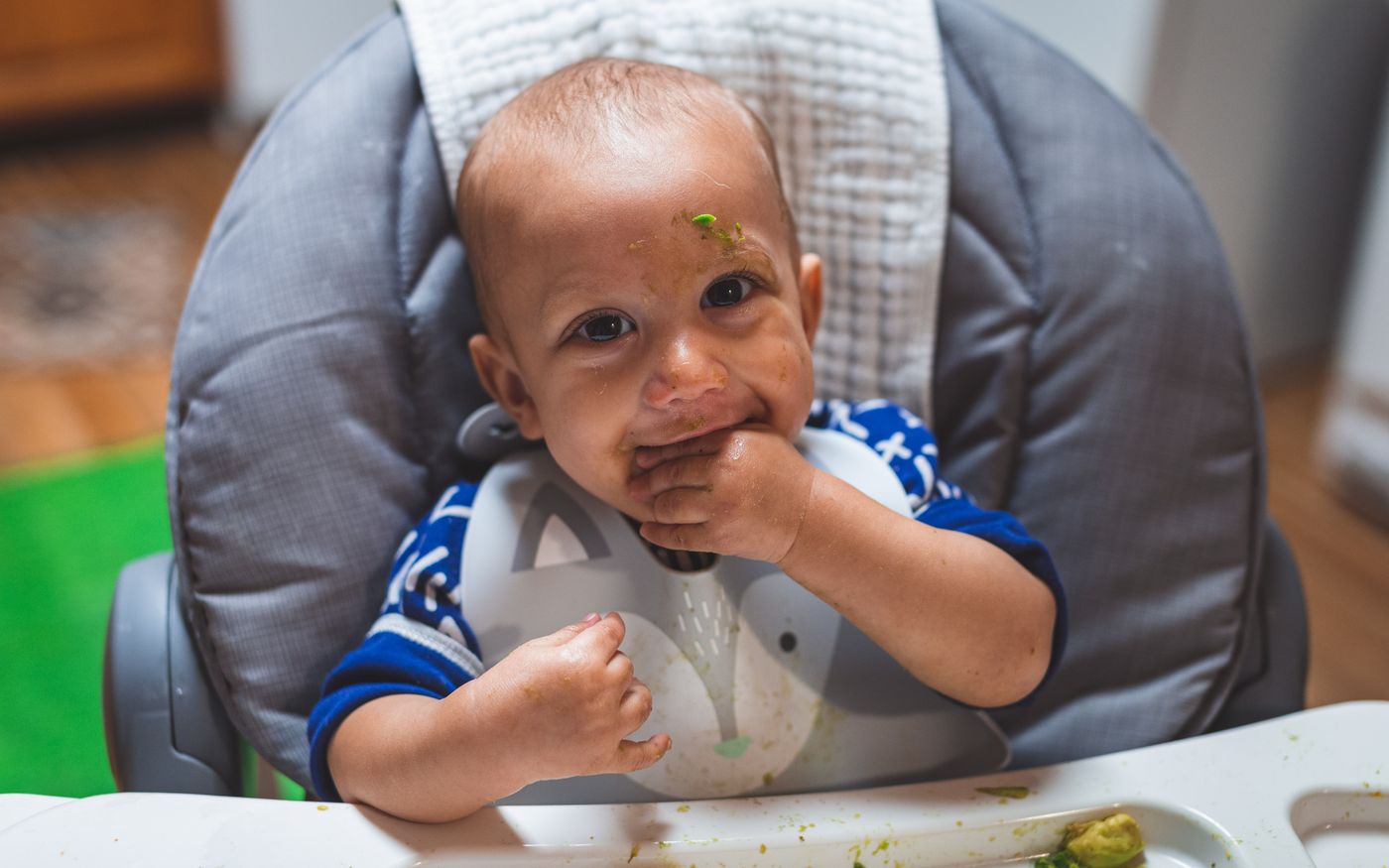
Hands come first, utensils later
Self-feeding is a long set of small skills, not a single day they “learn to use a spoon.” Most babies start by bringing a fist to the mouth, then raking food toward themselves, then picking up smaller pieces with a pincer grasp, then steering a spoon or a cup with a lot of misses. Those stages overlap. A baby can palmar-grasp a spear of soft sweet potato and still have no interest in a fork. That’s normal, not a delay you need to fix at dinner.
This sits after starting solids and next to first foods by age. It is not a chair-setup checklist—use the high chair setup for that—and it is not a campaign to keep every crumb off the floor. Mess is often the work. Contain it, as in our mess-free BLW guide, and let the hands do their job.
What the milestones usually look like
Early on, many babies use a palmar, or fist, grasp: the whole hand closes around a soft strip and finds the mouth with more luck than aim. That’s a real feeding skill. Offer foods shaped so a fist can hold them, and stay close. Raking comes as they pull food toward themselves on the tray, often messier than you wanted. Then, often later in the second half of the first year, a pincer grasp shows up: thumb and forefinger lift a small, soft piece. That’s when pea-size, squishable bits become useful practice—not hard, round choke hazards.
Spoons usually start as toys. A loaded spoon you hand over, plus a second spoon they hold, is more realistic than expecting a clean scoop at eight months. Many toddlers still need help loading into the second year. Cups follow a similar path: a tiny amount in an open cup, a simple straw cup, lots of spills, and short practice at the table rather than a wandering bottle. Our weaning off the bottle guide is about the later cup transition, not this early practice.
Two-handed work shows up too: stabilizing a bowl, holding a cup with both hands, or planting one hand and using the other. You can help by offering a bowl that doesn’t fly too easily, a cup with a little water, and food that actually sticks to a spoon. You cannot help by doing every bite for them once they’re clearly trying. Sit nearby, load the hard scoops, and let the clumsy ones land.
How to support the skill without turning dinner into therapy
Put food where their hands can reach it. Cut or mash to the grasp they have today, not the one you wish they had. If they only fist-grasp, give a spear; if they’re pinching, add a few soft bits. A pre-loaded spoon next to finger food covers both. Keep meals short enough that practice doesn’t curdle into a battle. When they’re done, they’re done, even if the tray looks unfinished.
Expect food on faces, bibs, and sometimes hair. That’s not a failure of manners. Table manners come much later—see teaching kids table manners—and even then, they rest on this earlier freedom to try. A wipeable bib, a contained tray, and a mat you can rinse will do more for your patience than asking a nine-month-old to stay tidy.
Resist the urge to jump to “advanced” tools because a photo looked cute. Curved spoons, weighted cups, and divided plates can help some families and irritate others. The milestone is the movement: hand to mouth, then more precise pickup, then a tool that sometimes works. If a gadget fights them, drop it and go back to fingers and a simple spoon.
When to ask, and what not to panic about
Ranges are wide. Some babies pinch early and still smear yogurt at fifteen months. Some want only to be fed and then, in a week, want to do everything. Offer the chance at most meals, don’t turn it into a test, and mention it at checkups if your baby isn’t bringing hands to the mouth, seems uninterested in touching food for a long stretch, or struggles with texture in a way that worries you. Your pediatrician can tell you whether that’s a wait-and-watch or a referral.
Choking safety doesn’t relax just because they’re “good at self-feeding.” Sit with them, keep them upright, and stay with the same hazard list: no honey under one, no hard or round pieces, no walking with food. Self-feeding is not unsupervised feeding. A skilled pincer grasp is not a substitute for a grown-up at the table.
If a well-meaning relative takes over every bite “to keep things clean,” give them a job that still leaves the baby a role: loading the spoon, offering a new piece, or handling cleanup. The point of the milestone is practice. A perfect, adult-fed meal can be useful when you’re late or they’re exhausted. It should not be the only way they ever meet food.
As they move into toddlerhood, the same hands will poke at iron-rich foods, snacks, and family dinners. The work you do now is simply giving them safe chances to try. That’s the whole method: food they can grab, a chair they can sit in, and a grown-up who stays.
Early cup practice turns into a toddler habit when drinks have a place at the table. See toddler drinks: milk, water, and juice.
This guide is part of our baby feeding guides, where related pieces are grouped in one place.
Quick FAQ
When should a baby start using a spoon?
Hands usually come first. Many babies play with a preloaded spoon months before they use it well. Offer the spoon beside finger foods and let the skill arrive unevenly.
Is it a problem if they still want to be fed sometimes?
No. Mixed help is normal. Keep offering chances to self-feed without turning dinner into a drill. A calm high-chair setup, like the one in our high chair checklist, makes practice easier.
When should we ask about delayed self-feeding?
If they have little interest in bringing food to their mouth well after peers, or other motor skills seem off, mention it at a well visit. Ordinary messy practice is not a delay.
The bottom line
Self-feeding grows from fist to rake to pincer, then to clumsy spoons and cups, over months, not one weekend. Match the food to the grasp they have, contain the mess, stay sitting with them, and treat utensils as a late, messy bonus. The hand that keeps finding the mouth is the milestone that matters.