
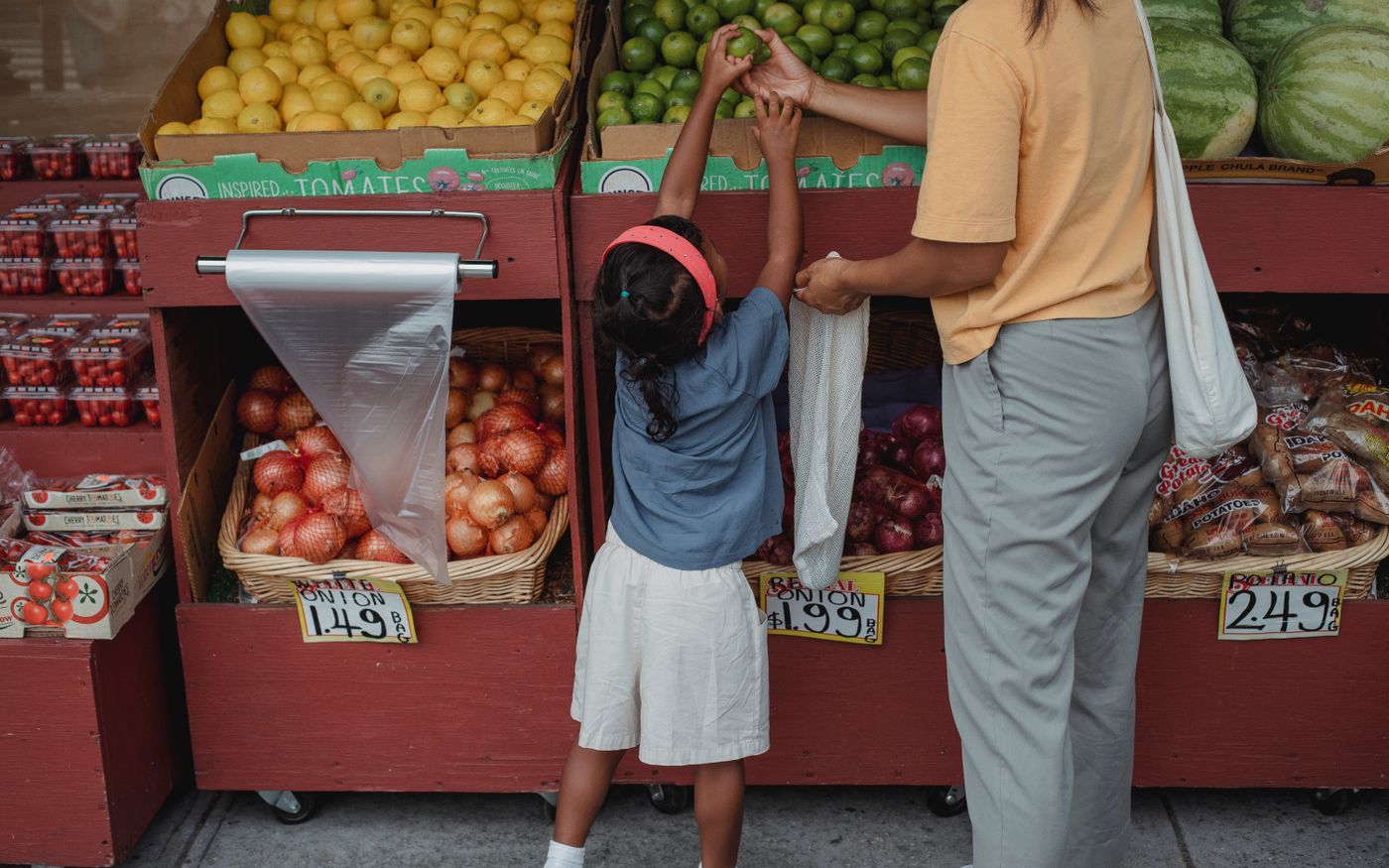
A market is a short loop, not a grocery store with tents
A farmers’ market with kids works when you pick a short loop, a small list, and a job they can do with their hands—choose the apples, carry a bag, say thank you to one vendor—then leave before the plaza is just a tired snack request. It is not the same as grocery shopping with toddlers, which is an indoor weekly errand with a cart and a list you have to finish. A market is seasonal, outdoor, and easier to overstay.
Go early if you can, when it’s cooler and less crowded, and eat something before you arrive so the first stall isn’t an emergency. Bring a bag or a wagon, water, wipes, and a plan for bathrooms if the site has one. A stroller can help with a tired toddler and the bags; a wagon helps if you actually intend to buy more than you can carry. Name the job before you park: “We’re getting berries and bread, and you can choose the berries.”
Choosing food, tasting, and keeping the list short
Let them pick one thing you are actually willing to buy and eat. A peach they chose is a better market lesson than a lecture about local farms. You still set the limits: we don’t squeeze every tomato, we wait our turn, we walk, we don’t run behind a stall. If samples are offered, sit or stand still to taste, and skip anything that isn’t safe for their age. Wash produce when you get home, the same as grocery fruit, before it hits a baby plate or a toddler snack.
Keep the list short on purpose. Markets are good for a few excellent things, not a full week of staples, unless you already know this one well. If you need the rest of the week, the grocery run can still happen another day. Use what you buy the same afternoon or in a meal you already cook—berries on yogurt, bread next to a soup, peppers on taco night, herbs on pasta. That closes the loop the same way growing food with kids tries to: the food reaches the table.
Cash or a card that actually works, a bag that doesn’t rip, and a grown-up who can say “not this week” without a debate in front of a display of donuts will save you. If they want a baked treat, decide the rule in advance: one shared thing, or a fruit they picked instead, or a treat on the way out. Don’t invent the rule at the stall.
Crowds, weather, and leaving on time
Stay together. Markets have edges, parking lots, and dogs on leashes. Hold a hand or use your usual parking-lot rule. In heat, keep it shorter and look for shade. In rain, a shorter loop or a skip is honest. A picnic on the grass with something you just bought can be the whole outing, and then you go home. You do not have to see every stall.
Leave while it’s still all right. A tired child in a crowded aisle of jars is how the morning ends. If they melt down, move to the edge, offer water, and go. You can come back next week. The market will still be there, and the strawberries you already bought still count.
A cautious eater may not taste a sample, and that’s fine. Seeing a vegetable on a table, or carrying it home, is already a kind of exposure—see picky eaters—without a guarantee they’ll eat it at dinner. Name the food, cook it the usual way, and skip the speech.
Make it a habit, not a field trip
If the market is near you, a regular short visit beats a rare, overfull “experience.” The same vendor, the same bag, the same one job. Kids remember the dog they weren’t supposed to pet and the peach they chose. You remember whether you actually used what you bought. That’s the measure.
When you get home, wash hands, wash the produce, and put it where you’ll see it. A market bag that dies in the trunk is a wasted loop. A single pint of berries eaten that afternoon is a complete success.
If they want to “pay,” let them hand over a bill or put an item on the scale with the vendor’s okay. That’s a tiny money and manners moment, not a math class, and it pairs with a simple thank-you. Vendors are usually kind about a short, supervised turn; they’re less kind about a child roaming behind the table. Your job is to stand there with them and then move on so the line can move too.
Market edges and parking lots are easy places to get split up. See if you get separated in public.
A market is a shopping loop; a fair is rides, barns, and a treat. See county fair with kids.
This guide is part of our mealtime guides and our travel and outings guides, where related pieces are grouped in one place.
A market run can use a tiny three-item version of the same list. See teaching kids to write a grocery list.
Quick FAQ
How is a market different from the grocery store?
It is a short loop with more people, samples, and things to touch—not a full weekly shop. Go with one or two jobs and a leave time, not a packed tote goal.
Should kids taste everything they are offered?
No. You can decline a sample, or choose one planned taste. A market is not an all-you-can-eat walk.
What if the weather or the crowds are too much?
Leave. A shorter visit you will repeat is better than finishing the loop miserable. You can also skip the market and cook with what you have.
The bottom line
Take kids to a farmers’ market on a short loop, with a small list and one real choosing job, then leave before anyone is wrecked. Taste standing still, wash the food at home, and use it in a meal you already cook. The pint you actually eat is the whole point.