
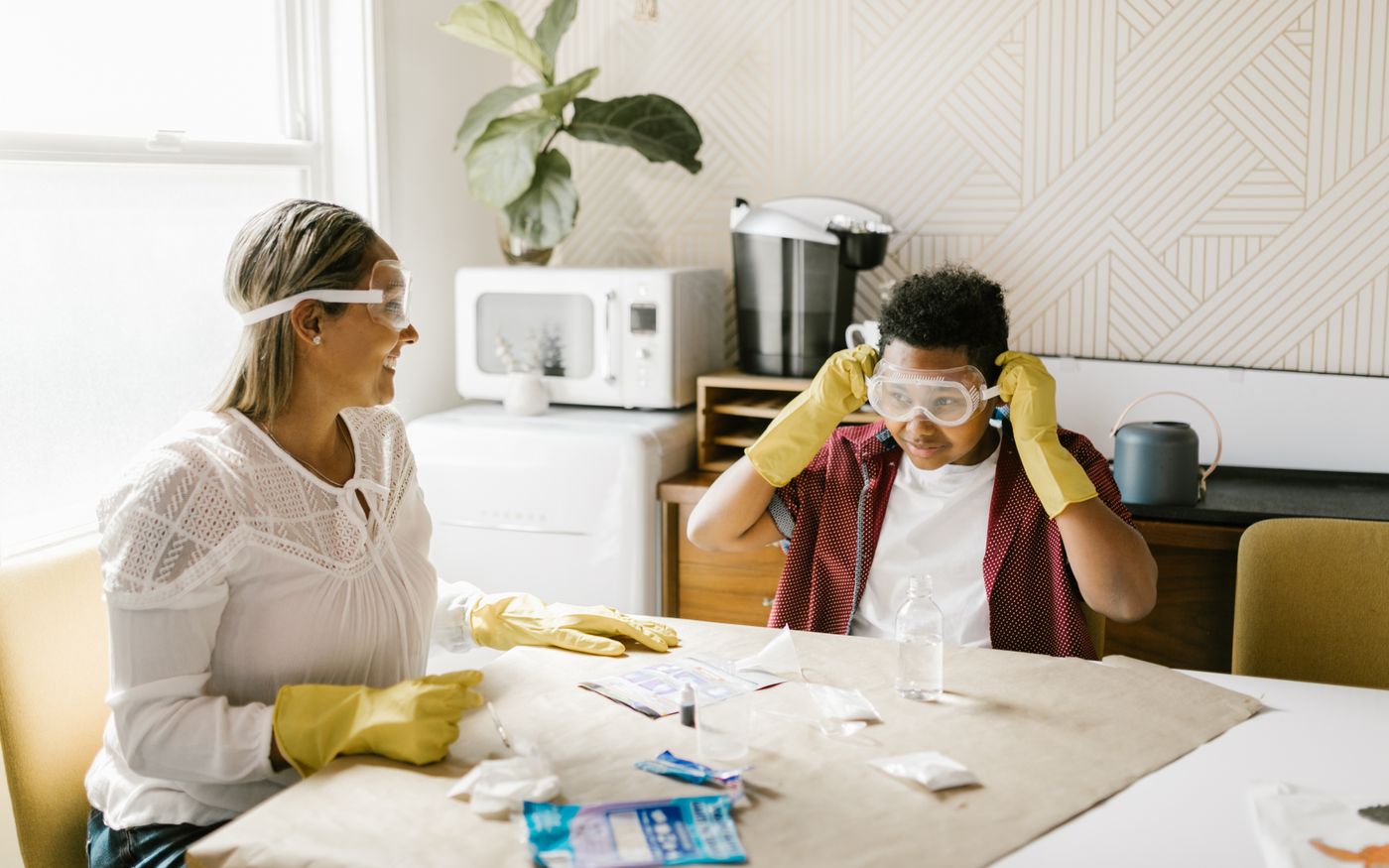
The best “lab” is the kitchen table
You don’t need a kit with 40 sealed packets. A few pantry staples, a tray, and 20 minutes will teach more than a complicated project you never start. Science at home works when it’s short, messy in a contained way, and finished while everyone is still interested. It also earns a place next to our rainy-day indoor ideas on a wet afternoon.
Pick one experiment, set it up before you invite them over, and decide in advance what “done” looks like: the volcano fizzes, the bag inflates, the celery changes color, or the ice melts. A clear ending keeps it from becoming an all-afternoon event you didn’t have the energy for.
A short safety talk, then get out of the way
Before you start: goggles or just “this stays on the tray,” no tasting unless the experiment is food, wash hands after, and an adult stays in the room. That’s enough. A stool, a towel, and a tray or baking sheet will save the table. If you’re already practicing a sink habit, wash first and last, as in teaching kids to wash hands.
Let them pour, stir, and predict. Your job is to keep the materials coming and to ask one good question: “What do you think will happen if we add more vinegar?” Write their guess on a scrap of paper if they like that kind of thing. You don’t have to lecture about carbon dioxide for the fizz to count as science.
Five experiments that actually work
- Baking soda and vinegar: A spoon of baking soda in a cup, vinegar poured slowly, optional dish soap and a drop of color. Put the cup on a tray. Talk about the bubbles, then do it again with a little more or a little less.
- A “magic” inflating bag: Baking soda in a paper towel, vinegar in a zip bag, seal, and watch it puff. Do this in the sink or over a tray. Don’t leave it sealed forever just to see what happens—open it over the tray when you’re done.
- Ice and salt: Two ice cubes, salt on one, and a watch to see which melts faster. Sprinkle a little color on top if you want the melt to show.
- Celery or a pale flower in colored water: This one is slow, which is the point. Check it at lunch and again at dinner. The color climbing the stem is the whole show.
- Sink and float: A bowl of water and a small pile of household objects (a spoon, a grape, a cork, a crayon). Guess first, then test. Dry everything when you’re done.
If they want to cook instead, that’s science too. Measuring, melting, and mixing in our cooking with toddlers guide uses the same “short, real job, adult nearby” frame.
What to say instead of a lecture
- “What do you notice?”
- “What should we try next—more, less, or the same?”
- “You predicted it would sink, and it floated. That’s useful.”
When it “fails”—the bag barely inflates, the flower doesn’t change—say so cheerfully and try a tweak. A failed try is still the habit you want: we asked a question and checked. A library picture book about weather, bodies, or kitchens can extend the afternoon; see library visits with toddlers if you want a short outing to pick one.
Cleanup, and how often to do this
Cleanup is part of the experiment. They can carry the tray to the sink, wipe the table, and put the baking soda away. Keep a small bin of “science tools” (cups, a funnel, a dropper if you have one, food coloring, a towel) so the next time doesn’t start with a scavenger hunt.
Once a week is plenty. A Saturday morning or a rainy after-school stretch is enough. You don’t have to build a science hour into every day. The goal is a child who expects that questions can be tested at the kitchen table—not a perfect lab notebook.
If you want a slightly bigger project, grow a bean in a wet paper towel in a clear cup, or make a shadow play with a flashlight after dark and trace the shapes. Both are cheap, slow, and easy to leave on a windowsill or a wall. Write the date on the cup, and look again tomorrow. That’s a science notebook without the notebook.
Store food coloring, baking soda, and vinegar together so you’re not shopping mid-project. Skip anything with heat, sealed bottles, or chemicals you wouldn’t put near a snack. If a project needs a stove or a sharp tool, it’s a demonstration they can watch, not a solo job.
Dough changing in the bowl is kitchen science, too. For a holiday tray with real kid jobs, see holiday baking with kids.
If they loved one exhibit, a simple kitchen experiment the next day extends the visit. For the outing itself, see museum visits with kids.
Quick FAQ
Do I need special science kits?
No. The kitchen table and a few ordinary supplies are enough. A short, finishable experiment beats a kit you never open.
How do we keep it safe?
A brief safety talk, a grown-up for heat and anything that could splash or break, then let them do the steps they can. Cleanup is part of the experiment.
How often should we do this?
Occasionally, when you have the time and the patience—not as a daily curriculum. A rainy afternoon is a natural cue. See rainy-day indoor activities for other quiet options.
The bottom line
Choose one short experiment, put it on a tray, let them pour, and ask what they notice. Kitchen-table science sticks when it’s small enough to finish—and messy only in the ways you planned.