
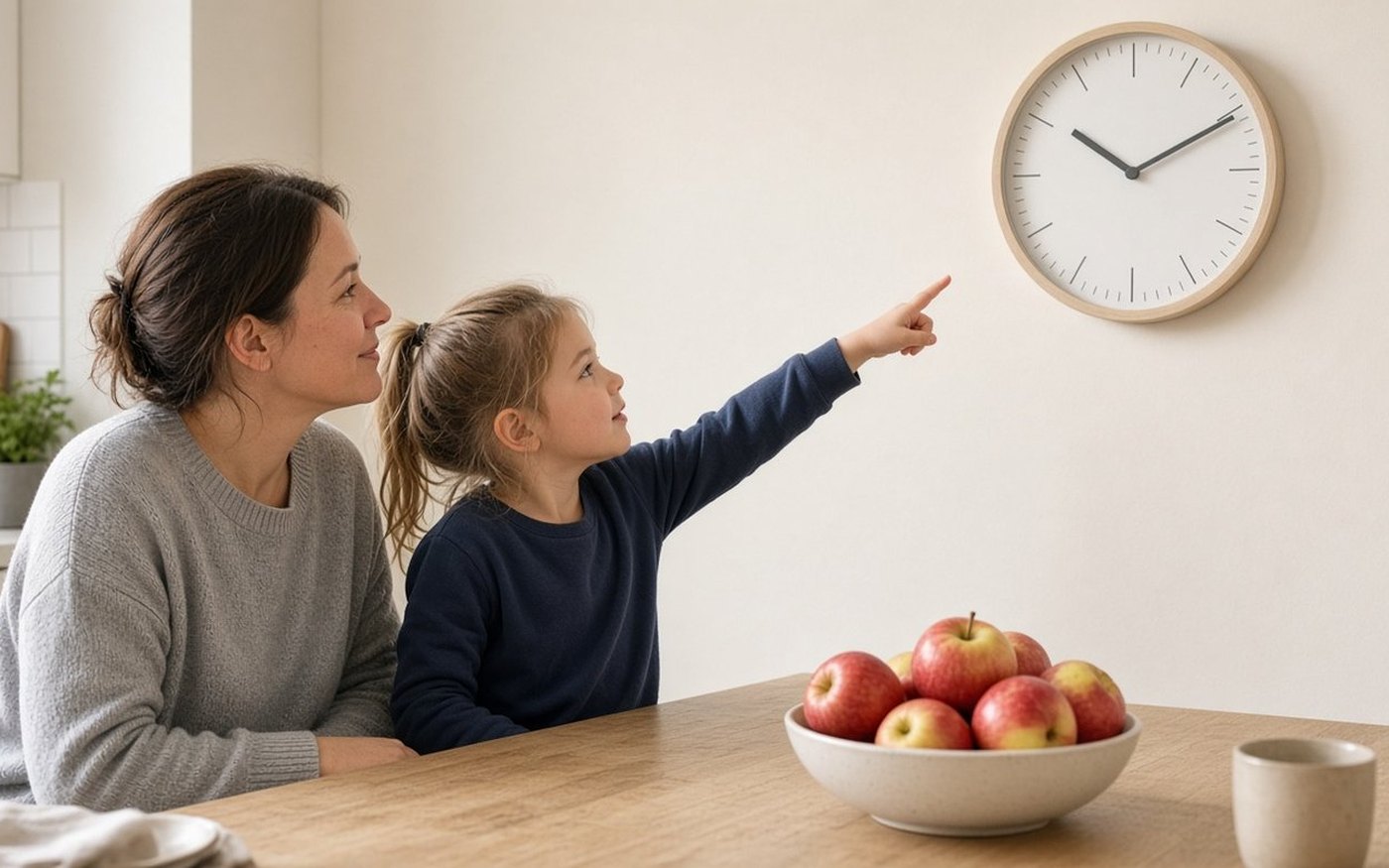
Telling time is two skills, not one
Kids learn to tell time in two separate pieces: understanding time (what “in five minutes” or “after lunch” means) and reading a clock (what the hands or numbers say). The first one starts in the preschool years. The second usually comes in kindergarten through second grade, with most kids reading an analog clock to the hour around age six and to five minutes by seven or eight. There is a wide normal range, so don’t worry if your child is early or late.
You don’t need worksheets or apps to teach it. A clock on the wall, a few minutes of practice on ordinary days, and talking about time out loud do most of the work. This guide walks through a simple order: time words first, then the hour hand, then the minute hand, then digital.
Start with time words before the clock
Before kids can read a clock, they need to know what time is for. Use time words naturally through the day: morning, afternoon, evening, before, after, soon, later, yesterday, tomorrow. Tie them to routines they already know. “After breakfast we brush teeth.” “We leave for school in the morning, and pick up in the afternoon.” A visual routine chart (see our after-school routine guide) gives young kids a picture of time passing.
Give them a feel for minutes. Use a kitchen timer for short waits: “The timer says five minutes until we go.” Kids start to understand how long a minute actually is when they feel it in a game or a wait. It also helps with transitions and with learning to wait.
Teach the hour hand first
Hang an analog clock where your child can see it, at eye level if you can: the kitchen or their bedroom. Choose one with clear numbers and two hands that look very different, a short thick hour hand and a long thin minute hand. Some parents put a small sticker on the hour hand to make it obvious.
Start with just the hour. Point out the short hand at meaningful times: “The short hand is on the 7. It’s 7 o’clock, time for breakfast.” “The short hand is on the 12. Lunch.” Ask them to look before an event they care about. A practice clock with gears (or a paper plate clock you make together) lets them move the hands themselves, which helps more than just watching.
Once they can name the hour, introduce “half past.” Show that when the long hand points straight down at the 6, it’s halfway around, so it’s half past the hour. Practice this for a while before moving on.
Then add the minute hand, five at a time
Counting by fives is the bridge to minutes. Kids who can count 5, 10, 15 can read the minute hand. Show how each number on the clock stands for five minutes: the 1 is 5 minutes, the 2 is 10, the 3 is 15, all the way around to 60. Point with your finger and count together as you go around the clock.
Practice with real times: “It’s 4:15. That’s a quarter past four. Fifteen more minutes until dinner.” Keep it to one or two questions a day, in a calm moment, not a quiz before school. Short, frequent practice works better than a long lesson. Quarter past and quarter to are tricky; it’s fine if “quarter to” comes later.
For a child who is ready, try a short game: you set the practice clock, they read it; then they set it and you read it (and sometimes get it wrong on purpose so they can correct you). Kids love catching a parent’s mistake.
Digital clocks, schedules, and real use
Digital clocks are easier to read, but they don’t show how time moves around the hour. Teach analog first, or at the same time. Once your child reads both, ask them to compare: “The kitchen clock says ten past three. What does the microwave say?” That connects the two systems.
The skill sticks when it has a job. Let an older child be the timekeeper for the morning: “Tell me when it’s 7:45, and we’ll put shoes on.” Ask them when a show ends or when practice starts. A watch, analog or simple digital, can be a good gift for a second grader who is ready. Time is also useful for other independence skills, like knowing when to start homework (see homework habits) or when screens end (screen time rules).
If your child struggles for a long time, especially with numbers or sequencing in general, mention it to their teacher. Some kids need more time or a different approach, and the teacher can tell you what the class is working on so your practice matches.
This guide is also listed in our life skills guides.
Quick FAQ
What age do kids learn to tell time?
Many kids read an analog clock to the hour around age six, to the half hour soon after, and to five minutes around seven or eight. There’s a wide normal range.
Should I teach analog or digital first?
Analog first, or both together. Analog shows how time moves around the hour, which makes “quarter past” and “ten minutes left” make sense.
How do I help a child who doesn’t get it yet?
Go back a step: time words and the hour hand. Practice a minute or two a day with a clock they can move. Ask their teacher what the class is using.
The bottom line
Teach time in a simple order: time words and routines, then the hour hand, half past, counting by fives, and finally digital. Hang a clear analog clock at their height, practice for a minute or two a day, and give them real jobs like calling out when it’s time to leave. The clock makes sense once time has a use in their day.